October Member of the Month
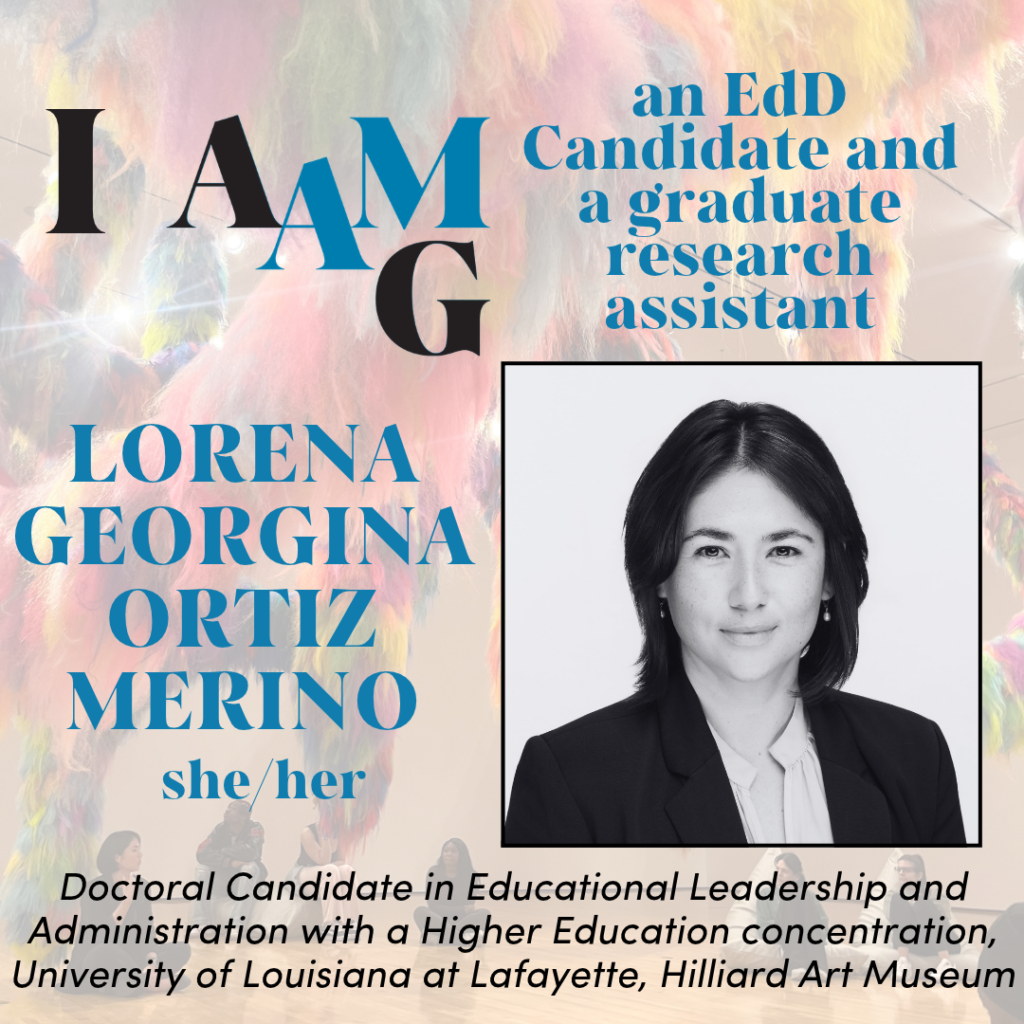
Meet Lorena Georgina Ortiz Merino (she/her), an EdD candidate in Educational Leadership and Administration and Graduate Research Assistant at the University of Louisiana at Lafayette, working with the Hilliard Art Museum!
What’s one thing — either industry/work-related or not — you learned in the past month?
Condition reporting Curtis Patterson’s loaned works for our fall exhibition gave me the opportunity to look much more closely at his technique and at the influences of jazz, the Civil Rights Movement, and Yoruba religion in his work. That experience sparked a broader curiosity about jazz and visual culture and led me to learn more about the photography behind Miles Davis’s Kind of Blue. I became fascinated by photographer Jay Maisel, who recently passed away, and by the story behind his now-iconic portrait of Davis. I especially enjoyed learning about Maisel’s attention to light, color, and gesture, and that the photograph was not originally created as an album commission—he had photographed Davis independently, and Columbia later selected the image for the cover. It was a wonderful reminder of how working closely with objects can open unexpected paths of learning far beyond the object itself.
What do you value about your membership with AAMG?
Above all, I value the AAMG community and the sense of belonging I have found within it. I have encountered people who are remarkably open, kind, generous, and willing to share their knowledge and experiences. AAMG has certainly been an extraordinary professional learning opportunity, but what I value just as much are the friendships, camaraderie, encouragement, and personal growth that come with being part of this community. It inspires me to continue becoming the best version of myself professionally and personally, while also looking for ways to contribute, support others, and serve the field with a stronger sense of purpose.
Coffee or Tea?
Tea, Chocolate de Agua, and Coffee!
Book/Author suggestion?
It’s quite difficult to choose just one! Elena Garro’s novel, Los recuerdos del porvenir, was translated in the late 60s as Recollections of Things to Come. Mexican magical realism at its finest, and some even claim that it is the origin of the genre.
What did you want to be when you were growing up?
As a child, I dreamed of becoming a veterinarian. Some of my oldest and most cherished childhood memories are of admiring fireflies and frogs. I love animals and love helping them whenever I can. My dog, Balú, loves kittens and helps me find and foster them, which often annoys my cat, Nino.
What do you enjoy most about being a part of an academic museum?
What I enjoy most about being part of an academic museum is the opportunity to wear many different hats. I can experiment, ask questions, and continue learning about remarkably different aspects of how a museum, a university, and its surrounding community work and interact. I can move between collections, exhibitions, education, research, student engagement, assessment, and community partnerships, often discovering connections among them that I would not have anticipated. I am not sure there are many other work environments where this kind of continuous, interdisciplinary learning would be possible, and that is one of the things I find most exciting about academic museums.
What are your hopes for our industry?
I hope museums—particularly academic museums—will increasingly prioritize student learning, development, practice, and meaningful opportunities to use the museum as a laboratory for experiential learning. I hope students can see museums not only as places where knowledge is presented, but as places where they can research, experiment, create, question, practice professional skills, and discover new possibilities for themselves. At the same time, I hope we preserve something equally important: the museum as a place where people can slow down, reconnect with their emotions, spend time in the presence of beauty, and engage in an internal dialogue inspired by art and objects. I hope our field continues to recognize that these intellectual, practical, emotional, and deeply human experiences can—and should—exist together.
If you could trade places with anyone for a day, who would it be?
If I could trade places with anyone for a day, I would choose Alondra de la Parra, the incredible Mexican conductor. I would love to experience music as intensely as she does and embrace it with her level of knowledge and passion.
Do you have a favorite joke to share?
One of my favorites is a rather dark Mexican history joke: “El mundo es de los aventados.” —Juan Escutia. Unfortunately, it requires enough historical context and translation that explaining it completely ruins it. So my safer answer is: I used to think I was indecisive. Now I’m not so sure.